
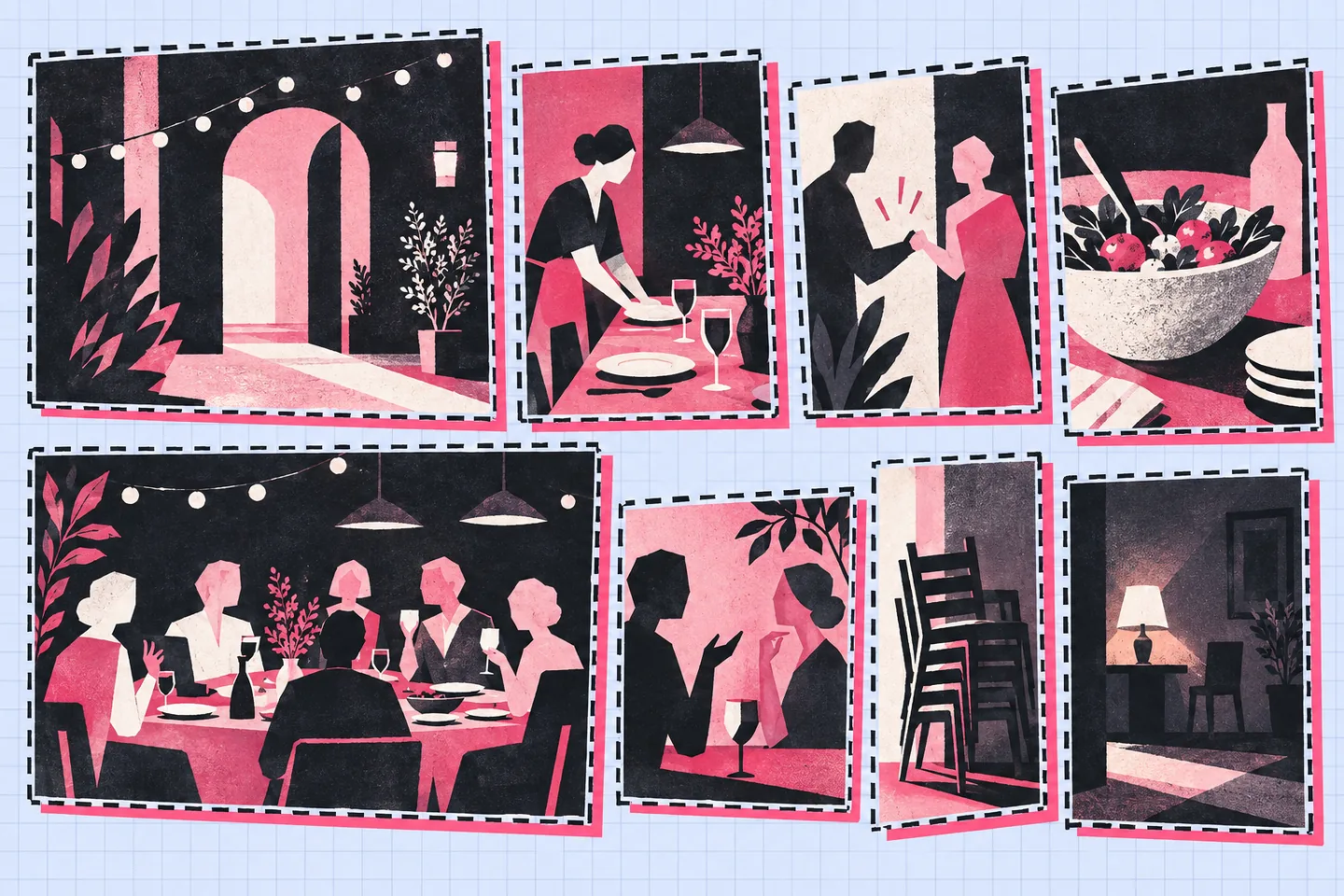
An event gallery can contain strong photographs and still leave a viewer unsure what happened. A sequence must introduce the place, show how people interacted and give the gathering an ending. Begin the edit after the event, when you can compare what the photographs say together.
Adobe’s visual storytelling guide recommends wide establishing views, medium action and close details within a narrative. Those perspectives offer a useful test for a gallery: does each selected frame contribute something the others cannot?
Choose a set with a beginning, a middle and an end
Lay out a contact sheet of plausible candidates. Make one pass for technical quality and another for story. Find an establishing view, interactions that show what people did, details particular to the occasion and a closing frame. The ending need not show everyone leaving; one person folding a tablecloth after a shared meal might say enough.
Be firm with near-duplicates. Two photographs of the same greeting, made from almost the same position, rarely carry twice the meaning. Choose the clearer gesture or background. Keep a similar frame if it advances the action: a hand reaching towards someone and the conversation that follows may form a useful pair.
Do not let the loudest moment stand for the whole event. Applause may be memorable, but welcoming guests, serving food and clearing the space show other parts of the gathering. Look for people whose roles would disappear if you selected only dramatic frames. Aim for a concise account, rather than equal screen time for every attendee.
Chronological or thematic: choose the order that tells the truth
Chronology is usually the clearest starting point. Arrival leads to preparation, activity and departure. It gives someone who was absent a dependable path through the day, especially when the event changed visibly over time.
A thematic sequence groups images by ideas: work behind the gathering, moments of welcome, exchanges across a table and the room at rest. It can open more vividly than a strict timeline, but a changed order can imply a false chain of events. A photograph of someone leaving immediately after an argument might suggest a connection the images cannot establish. Keep capture order available while editing and explain any significant time shift in a caption.
Adobe’s photojournalism guidance discusses how publication context affects photographs and how reviewing an edit can reveal a story. An event gallery is not necessarily journalism, but neighbouring frames still affect how a viewer reads a moment.
A worked twelve-frame contact-sheet edit
Imagine a community supper photographed in the following capture order. These candidates are hypothetical. The aim is a short public gallery that shows both the meal and the work around it.
- Exterior, with the supper sign and guests approaching — keep. It identifies the place and purpose without a lengthy caption. The approaching figures give the opening some movement.
- A second exterior from a slightly lower angle — cut. Its light is attractive, but it supplies no new information after frame 1. Keeping both would delay our arrival inside.
- Volunteers setting a long table — keep. This adds the work that made the gathering possible and introduces people before the room fills.
- Another view of the same volunteer placing the same plates — cut. The gesture repeats frame 3. A tighter crop alone is not enough reason to keep it.
- A guest being welcomed at the door — keep. Preparation becomes participation. The greeting is readable even to someone who knows neither person.
- A second frame from that greeting — cut. One face is more visible, but the gesture has ended and the background obscures the doorway. It weakens the transition.
- A portrait of one guest looking at the camera — cut from this short story. It may be a lovely photograph and worth delivering elsewhere. Here, it pauses the action without telling us what the guest is doing.
- Hands passing a serving dish — keep. The close view changes scale and shows a specific exchange. It is a detail with action, rather than decoration alone.
- A wide view of the occupied table — keep. It connects the earlier gestures to the gathering as a whole and lets the viewer understand the room.
- Two guests in quiet conversation — keep. This gives the middle of the story a smaller, calmer beat after the busy wide view.
- Volunteers stacking chairs — keep. It marks the event winding down and returns attention to the people whose work opened the sequence.
- The cleared room, with one light still on — keep. This is a restrained ending. It allows the viewer to register the change from frame 1 without inventing a final dramatic moment.
The chronological eight-frame edit is 1, 3, 5, 8, 9, 10, 11, 12. It takes the viewer from arrival through the meal to the empty room. The cuts remove repetition and a portrait better seen alone; they are decisions about this sequence, not judgments on the photographs themselves.
A thematic version could begin 8, 1, 3, 5, 9, 10, 11, 12. The passing dish opens with sharing before the exterior supplies context. Because that first image was made later, a caption such as “During the community supper, guests passed dishes along the table” makes the time shift clear. The same eight photographs can emphasise different aspects of the gathering without changing what happened.
Read the sequence at gallery size
A contact sheet helps comparison, but visitors often see one frame at a time. Step through the proposed order at the size they will use. Several wide room views can feel distant; several tight details can make the setting hard to place. Changes in scale and pace should help the viewer follow the event.
Pay attention to the joins between frames. If a detail appears before the wide view that explains it, decide whether the brief uncertainty invites interest or simply confuses. If two consecutive pictures show the same people from nearly identical positions, replace one with a different action or viewpoint. Test the sequence again after every substantial move; a strong image can weaken the story in the wrong place.
World Press Photo jury commentary on a photographic story describes consistency and rhythm across a sequence. In an event gallery, a quiet exchange after a crowded scene can give the viewer time to notice who is there. An action after two still moments can move the story on. Avoid mechanical alternation: each change should serve the account.
Check who appears repeatedly and who is absent. Are the hosts, guests and people doing the work visible in a way that reflects the gathering? Does one unflattering instant become the only image of someone? Selection can distort an occasion even when no individual photograph has been altered. Return to the full contact sheet if the edit seems too narrow.
Make context clear before the gallery goes public
Read the sequence once without captions. The setting and broad progression should be understandable even if not every person is named. Then add captions for facts the photographs cannot establish alone: the event’s name, a verified role or a time shift. Describe what is visible and what you know. A glance across a room does not prove disagreement, surprise or joy.
Before sharing, check the organiser’s instructions, agreements governing the photographs and restrictions communicated by people pictured. Take particular care with private moments and images of children. A photograph suitable for personal delivery may call for a different decision in a public gallery. Confirm any name or role used in a caption.